


Soil Testing: Why Fall Is a Good Time to Check Your Lawn's Health

Most homeowners only think about their soil in spring, usually right when something's already visibly wrong with the lawn. Testing in fall flips that around — instead of reacting to a problem, a fall soil test gives any real issue months to actually get fixed before the growing season starts again.
What a Soil Test Actually Tells You
USU Extension describes soil testing as a way to determine whether nutrients are deficient, and if so, how much is needed to fix it — but it also catches the opposite problem: excess nutrients and salts, high pH, low organic matter, and poor drainage are all things a soil test can flag that a homeowner would otherwise only notice once the lawn was already struggling.

Why Fall Specifically
Two things make fall a genuinely better window than spring, not just an equally fine alternative. University of Connecticut Extension points out that soil labs are less busy in fall than in spring, so results tend to come back faster outside the spring rush. More importantly, amendments like lime need real time to break down and work into the soil chemistry — University of Vermont Extension notes that large lime corrections are often split between fall and spring applications specifically because of this lag. Test in fall, and by the time spring rolls around, UConn Extension notes the only decision left is which fertilizer to use — the bigger corrections have already had a season to take effect.
How to Actually Take a Sample
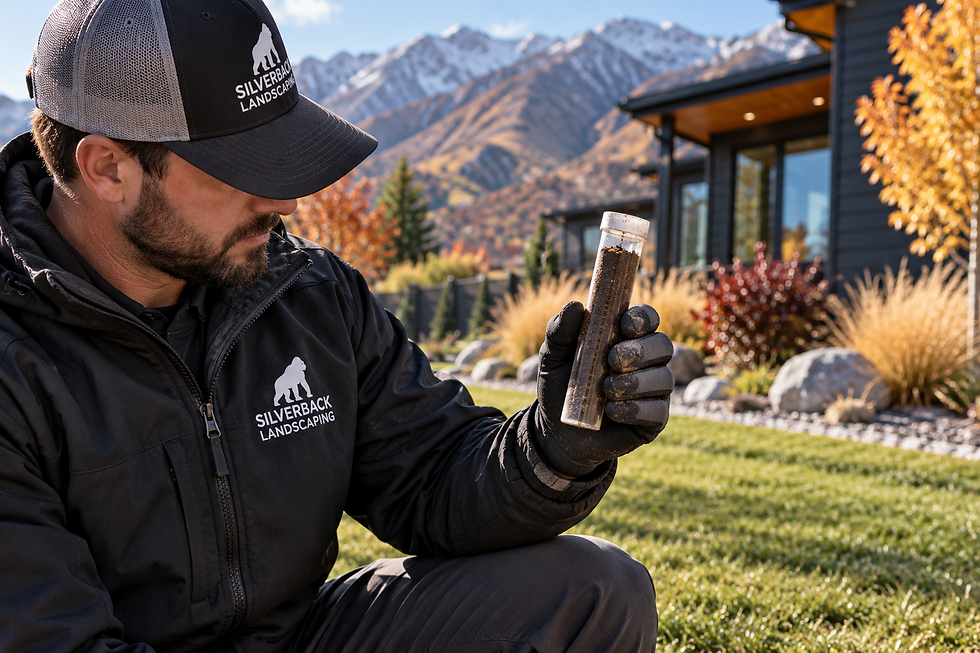
Dig to the right depth. USU Extension recommends 6 inches deep for a turf/lawn sample (deeper, 6–12 inches, for general topsoil beds).
Sample from several spots, not just one. A single spot doesn't represent the whole yard — USU Extension's guidance calls for samples from multiple locations across the area being tested.
Mix it together before sending it in. Combine the samples in a clean container and break apart any soil clumps so the lab gets a genuinely blended sample, not one spot's reading standing in for the whole lawn.
Package it the way the lab expects. USU Extension's process: about two cups of the mixed soil into a heavy-duty, quart-sized resealable bag, with the completed order form, mailed in a small box.

FAQs
How often should a lawn actually be retested?
There's no universal interval — a reasonable trigger is whenever there's a recurring problem that's hard to diagnose by eye, or before a bigger investment like a full lawn renovation, rather than testing on a fixed schedule regardless of how the lawn's doing.
Are at-home pH test kits a decent substitute for a lab test?
A quick at-home kit can give a rough pH reading, but a lab test through an extension-affiliated soil lab gives a fuller picture — nutrient levels, organic matter, salts — not just one number.
Does soil testing interfere with other fall work like overseeding or aeration?
No — testing pairs fine with either. If anything, knowing what the soil actually needs before overseeding or aerating means any amendment can go down at the same time instead of as a separate trip. Our guide to lawn aeration covers the piece that often gets paired with this.
Should I take the sample myself, or have someone else do it?
Taking a decent sample is straightforward, but getting one that actually represents the whole yard — rather than one lucky or unlucky spot — takes a bit of care. Get a free quote → and we can pull a proper sample and walk through what the results actually mean for your yard.



Comments